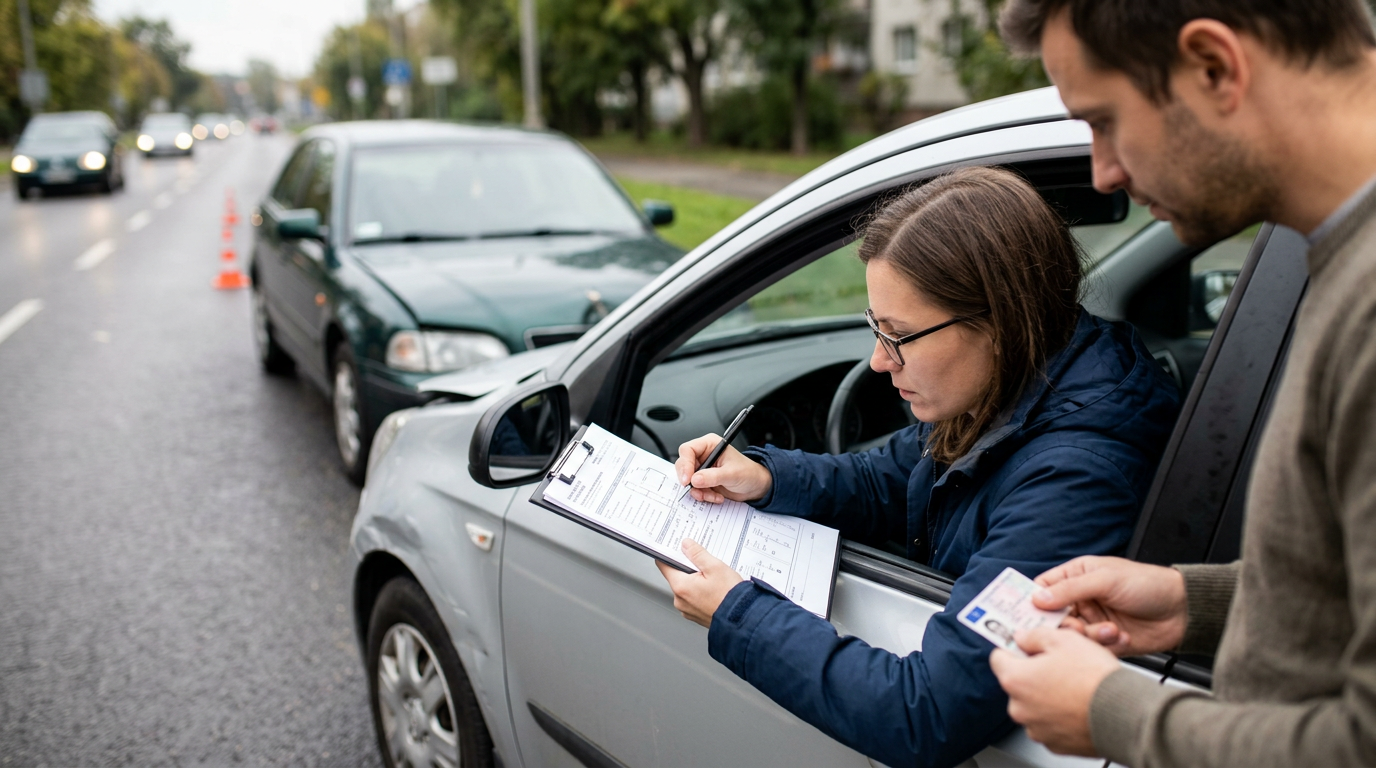
You’ve just been in an accident. Your heart races as the other driver approaches with a form and pen. You suddenly realize you’re unsure what to write.
Most drivers haven’t filled out these forms before. Many are unsure what information matters, what to diagram, or whether to admit fault.
The accident report form—also called the “European Accident Statement” or “Constat Amiable”—is vital. What you write affects fault, insurance, and costs.
I’ll guide you step by step, so you get it right, even if you’re shaken.
Before You Start: Get the Right Form
It’s best to learn how to fill out an accident report form before you ever need to use one.
Here’s what you can do today: Ask your insurance company for a printed form and keep it in your glove compartment. Download a digital version to your phone, too. Many insurers offer apps with digital forms. Also, make sure you always have a working pen in your car.
If you don’t have a form at the scene, ask the other driver—most insurers provide them. If no one has a form, write down all the information on a piece of paper or in your phone notes. You can complete an official form later.
Section 1: Basic Information
This part is simple, but make sure you fill out every field.
For the date and time, write them down exactly. If you’re not sure, check your phone or your car’s clock for precision.
For the location, include the street name, city, and any landmarks. Add the direction you were traveling. For example: “Main Street, heading north, 50 meters south of the traffic light at Oak Avenue.”
Provide your full name as on your driver’s license, your address, phone, license number, insurance company, and policy number.
Ask the other driver for these details and write exactly what they provide.
Record the vehicle make, model, license plate, and, if possible, the vehicle identification number (VIN).
Section 2: The Diagram
Most drivers make mistakes here. The diagram is the most important section. It shows the insurance adjuster what happened without relying on words that can be misinterpreted.
Start by drawing the road. Draw straight lines for the road’s edges. Add lane markings if applicable.
Draw your vehicle as a simple rectangle. Label it with your vehicle number, usually 1 or A.
Draw the other vehicle as a rectangle. Label it with their number, usually 2 or B.
Add arrows to show each vehicle’s direction.
Mark the impact point where the vehicles hit each other with an X or a star.
Include any traffic controls such as traffic lights, stop signs, yield signs, or roundabouts.
Note landmarks like buildings, trees, intersections, or anything that helps identify the exact location.
Don’t draw after moving cars. Complete the diagram before moving vehicles. If already moved, draw from memory and note it.
Keep your diagram simple. Focus on the basic layout for the adjuster.
Use the pre-printed symbols. Most forms have arrows, boxes, and other symbols. Use them.
Label everything clearly. If something is unclear, add a note.
Section 3: The Description
This section asks you to describe what happened. Be careful. What you write can be used against you.
Write only facts. No opinions, emotions, or assumptions.
A good description sounds like this: “Vehicle A was traveling north on Main Street at approximately 30 km/h. Vehicle B was stopped at the stop sign on Oak Avenue. Vehicle B pulled into the intersection and struck Vehicle A on the front passenger side.”
A bad description sounds like this: “I was driving carefully, and the other driver came out of nowhere and hit me. It was completely their fault.”
Don’t write “I’m sorry” or admit fault. Don’t accuse without evidence. Only mention visible injuries. Don’t note distraction, phone use, or alcohol.
Never state what you didn’t see or measure. Only list direct observations.
Section 4: Damage Description
This section asks you to describe the damage to each vehicle. Most forms have a diagram of a car with numbered sections.
On the vehicle diagram, mark which areas are damaged. Common areas include the front, rear, driver’s side, passenger’s side, roof, and undercarriage.
Write a brief description, such as “scratches and dents on front bumper,” “cracked headlight,” or “broken windshield.”
Don’t exaggerate or guess. If unsure if damage existed before, leave it blank.
Section 5: Witnesses and Police
If there were witnesses, write their names and phone numbers in this section. Include their full name, phone number, and a brief note about what they saw, such as “Witness saw Vehicle B run the stop sign.”
If the police attended the scene, write the police department name, the officer’s name and badge number, and the incident or report number.
Section 6: Signatures
Many drivers make mistakes here. Signing means you agree information is accurate—not that you admit fault.
Read the whole form before signing. If you disagree, note “I do not agree.” If the other driver doesn’t sign, write that on your copy.
You don’t have to sign at the scene. If unsure, complete at home and submit to your insurer within 7 days.
Common Mistakes to Avoid
Never admit fault. Do not write “I’m sorry” or “it was my fault.” Let insurers determine fault.
Do not leave sections blank. If a section does not apply, write “N/A.” Empty spaces look suspicious.
Complete the diagram before moving the vehicles. If you moved them, note this on the form.
Do not forget to take photos. The form is important, but photos are evidence. Take photos before filling out the form.
Do not sign without reading. The other driver may have written something incorrectly. Read every word before signing. You Don’t Have a Form
If no accident report form is available at the scene, don’t panic—here’s what you need to do instead.
First, write down all the information on paper or in your phone notes.
Second, take photos of both vehicles, the license plates, the other driver’s license and insurance card, and the scene.
Third, collect the names and phone numbers of any witnesses.
Fourth, draw a diagram of the accident on paper.
Fifth, contact your insurer as soon as possible. They will help you complete a form online or send you one.
The Bottom Line
The accident report form is your voice after a crash. It tells your insurance company what happened before anyone else can tell a different story.
Carefully fill it out. Stick to facts. Don’t admit fault. Complete the diagram before moving cars. Take photos. Gather witness info. Read everything before you sign.
Keep a blank form and a pen in your glove compartment today. You hope you never need it. But if you do, you will be ready.